OTS AI Datasets & Custom Egocentric Video Collection
Liyakathali K T
Author
Off-the-Shelf AI Datasets vs. Custom Egocentric Video Data Collection: A Guide for AI and Robotics Teams
Published by: Loopernode Technologies
Category: AI Data Collection | Physical AI | Robotics | Multimodal AI
Estimated reading time: 8–10 minutes
Artificial intelligence is moving beyond text-based applications into systems that understand images, interpret human actions, process video, and interact with the physical world. As AI models become more capable, the demand for relevant, diverse, and reliable training data continues to grow.
For AI developers, machine learning engineers, robotics companies, and research teams, finding the right data is an increasingly important part of model development.
However, obtaining suitable training data is not always straightforward. Public datasets may not cover a specific task or environment. Existing commercial datasets may not include the metadata, licensing rights, or technical formats a project requires. Collecting new data from scratch can introduce additional costs, operational complexity, and lead time.
Two approaches can help organizations address these challenges:
Off-the-shelf (OTS) datasets: Existing datasets that may be available for purchase, licensing, or access under specific terms.
Custom data collection: Purpose-built datasets collected according to a project's specific requirements, including specialized egocentric video for robotics and Physical AI.
At Loopernode Technologies, we help organizations explore AI data collection, dataset sourcing, annotation, and data preparation requirements. This guide explains how OTS datasets and custom egocentric video collection work, when each approach makes sense, and what to consider before selecting a data partner.
1. What Are Off-the-Shelf (OTS) AI Datasets?
Off-the-shelf datasets are existing collections of data that can be evaluated for use in AI training, fine-tuning, benchmarking, or research. Depending on the provider and licensing arrangement, datasets may be available for immediate access or require additional review and approval.
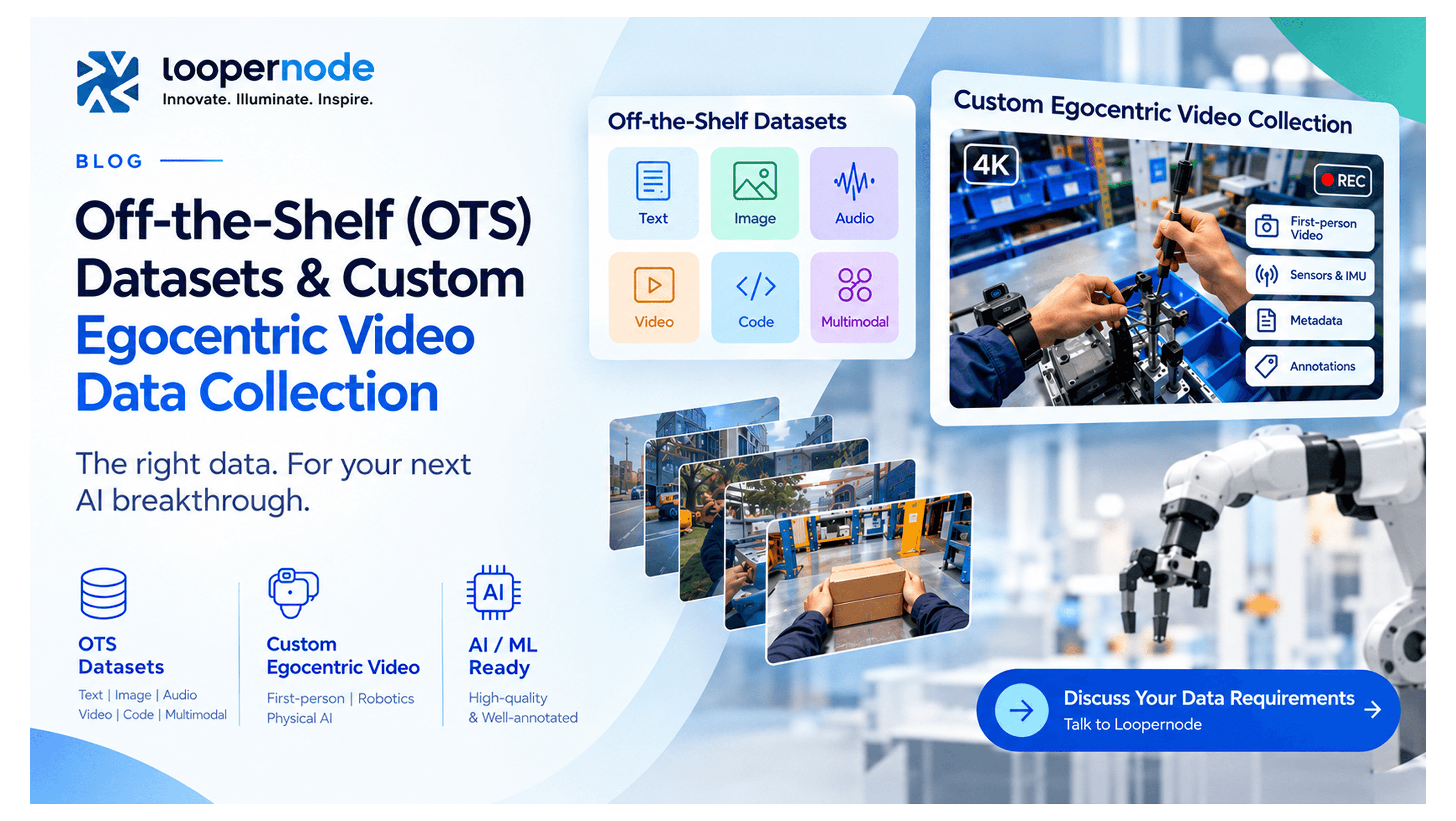
OTS datasets can cover a wide range of data types:
Text datasets: Documents, conversations, domain-specific text, and language-model training data.
Image datasets: Object images, scenes, product photographs, and computer vision data.
Audio datasets: Speech recordings, multilingual speech, environmental sounds, and acoustic data.
Video datasets: Human activities, object interactions, movement, and scene understanding.
Code datasets: Source code and associated documentation, subject to applicable licensing.
Multimodal datasets: Combinations of text, images, audio, video, and associated metadata.
The suitability of an OTS dataset depends on its content, coverage, quality, format, and permitted use—not simply its size.
Why Are Companies Choosing OTS Datasets?
Faster access to training data
An existing dataset can help teams begin experimentation without organizing an entirely new collection campaign.
Lower initial collection overhead
When suitable data already exists, organizations may avoid some of the equipment, recruitment, coordination, and fieldwork involved in collecting it themselves.
Support for prototyping and benchmarking
Researchers can use existing datasets to test pipelines, establish baselines, and evaluate initial model performance.
Access to diverse examples
A well-documented dataset may include multiple environments, object categories, languages, participants, or activities that would be expensive to reproduce independently.
What Should Buyers Verify Before Licensing an OTS Dataset?
Before purchasing or integrating a dataset, AI teams should review:
Data coverage: Does it include the required tasks, environments, languages, objects, and edge cases?
Licensing and permitted use: Does the license allow the intended commercial, research, training, or redistribution use?
Data provenance: Is the source of the data documented, and are the necessary rights and permissions established?
Technical specifications: Are the resolution, file format, duration, sampling rate, and metadata compatible with the project?
Annotation quality: Are labels available, and have their accuracy and consistency been evaluated?
Privacy and consent: Have relevant privacy obligations and permissions been addressed?
Availability and delivery: Are the requested volume, sample access, and delivery schedule confirmed?
An existing dataset should never be assumed to be suitable merely because it is advertised as available for AI training. Licensing restrictions and source-content rights require particular attention.
2. What Is Custom AI Data Collection?
Custom AI data collection involves gathering new data according to predefined project specifications.
Instead of adapting a model to the limitations of an existing dataset, an organization can define the data it needs and develop a collection plan around its intended application.
A custom collection project may specify:
Required data modalities
Target locations and environments
Participant or worker profiles
Activities, tasks, and object interactions
Recording equipment and technical parameters
Languages, accents, or demographic representation
Metadata fields and annotation requirements
Data volume and delivery schedule
Consent, privacy, and quality-control procedures
Custom collection is particularly valuable when the required data is uncommon, highly specialized, or unavailable in an existing dataset.
For example, a robotics developer training a model to understand how workers assemble products may need first-person recordings of specific assembly tasks, captured using particular cameras and accompanied by synchronized sensor information.
A general-purpose video dataset may not satisfy those requirements. A purpose-built collection may be more appropriate.
3. Understanding Egocentric Video Data Collection
<underline>Egocentric video</underline> is video recorded from the first-person perspective of the person performing an activity. The camera moves with the participant, capturing what they see while interacting with objects and their surroundings.
Unlike conventional third-person video, which records a person from an external viewpoint, egocentric video provides a closer view of human actions, hand movements, object manipulation, and task sequences.
This makes it a valuable data source for research and development in robotics, embodied AI, and human activity understanding.
Research projects such as Ego4D and EgoDex demonstrate how first-person recordings can support activity understanding and the study of human-object interactions. EgoDex, in particular, explores dexterous manipulation using egocentric video paired with hand-tracking information.
How Is Egocentric Video Used?
Robotics and Physical AI
Robotics teams can use human demonstrations to investigate how objects are handled, how tasks are performed, and how actions unfold in real environments.
Vision-language-action models
First-person video, when paired with suitable annotations or action information, can contribute to research connecting visual observations, language instructions, and physical actions.
Human activity recognition
Egocentric recordings can help models identify activities, understand task sequences, and distinguish between different types of human interaction.
Industrial automation
Recordings of manufacturing, assembly, packaging, inspection, and material handling may support research into robotic assistance and automated workflows.
Manipulation and object interaction
Close-up recordings of grasping, sorting, fastening, opening, placing, and handling objects can provide useful examples for models studying fine-grained actions.
The value of this data depends on the target application, capture quality, task diversity, annotations, and whether the collected information supports the intended training objective.
4. Why Is Custom Egocentric Video Becoming Important in 2026?
Physical AI and robotics are creating new requirements for training data. Systems designed to operate in the real world need more than static images or descriptions of objects. They may need to learn from sequences of actions, interactions, and changes in the surrounding environment.
In November 2025, IBM highlighted the difficulty of developing robotics datasets because real-world physical interactions must often be collected and curated specifically for the intended application. Research published at CVPR 2026 has also explored new methods for collecting first-person human video for embodied AI.
These developments point to several important considerations for organizations sourcing data.
Real-world task diversity matters
A model trained on a narrow collection of activities may struggle when it encounters unfamiliar objects, environments, or task variations. Diverse recordings can help researchers investigate these generalization challenges.
Existing datasets may not cover specialized workflows
Public datasets can provide valuable starting points, but a company developing a system for a specific industrial process may need recordings of tasks that are not adequately represented in available data.
Video alone may not be enough
Some projects require more than ordinary first-person footage. They may need synchronized camera views, hand or body tracking, timestamps, motion sensors, camera calibration, or structured task annotations.
Data rights and provenance are increasingly important
AI teams need to understand where their training data came from, how it was collected, what permissions apply, and whether its intended use is authorized.
For these reasons, the right sourcing strategy increasingly involves evaluating the actual requirements of a project rather than choosing a dataset based only on its size or price.
5. OTS Datasets vs. Custom Egocentric Video Collection
Both approaches can support AI development, but they solve different problems.
Evaluation factorOTS datasetsCustom egocentric collectionAvailabilityPotentially faster when suitable data is readyRequires planning and collectionInitial setupDataset evaluation and licensingRequirements, equipment, participants, and workflow setupTask specificityLimited to available coverageCan be designed around specified tasksEnvironment controlDepends on existing recordingsCollection environments can be definedTechnical formatExisting formats may require conversionCapture and delivery formats can be specifiedMetadataDepends on the datasetRequired metadata can be defined in advanceCost structureLicensing, access, and processing costsCollection, equipment, operations, QA, and processing costsBest suited forPrototyping, benchmarking, and covered use casesSpecialized tasks, missing coverage, and tailored training data
Which option is better?
Neither option is universally better. The correct choice depends on the data gap, project timeline, budget, licensing conditions, and technical requirements.
An OTS dataset may be the best choice when the required examples already exist and are legally available for the intended use. Custom collection becomes more attractive when existing datasets do not adequately cover the target tasks, environments, or technical specifications.
Many projects can benefit from a hybrid approach: use existing datasets for initial development and commission additional data to address specific gaps.
6. Technical Requirements for Custom Egocentric Video Collection
A successful collection project begins with a clear technical specification. Agreeing on these details before recording helps reduce unusable footage, unexpected costs, and delivery delays.
Camera and recording specifications
The collection plan should define:
Camera type and mounting position
Resolution and frame rate
Field of view
Color depth and output format
Video compression or raw recording requirements
Recording duration and segmentation rules
Lighting and environmental conditions
For instance, a project may require high-resolution footage at 30 frames per second. Another may require a wider field of view or an uncompressed or raw video output. The actual requirements must be confirmed with the client and validated against the available equipment.
Stereo and synchronized video
Some Physical AI projects require two camera streams that record the same activity from left and right viewpoints.
These projects may need:
Two synchronized camera streams
Verified timestamp alignment
Camera calibration parameters
Consistent recording settings
Defined procedures for checking synchronization and missing frames
Two cameras alone do not guarantee a technically valid stereo dataset. The hardware and collection workflow must support the required synchronization and calibration.
IMU and additional sensor data
Depending on the use case, projects may require inertial measurement unit (IMU) readings or other time-aligned sensor data.
Requirements should define sensor type, sampling frequency, timestamp conventions, coordinate frames, and how sensor records are aligned with the video.
Metadata and task documentation
Useful metadata can include:
Unique recording and task IDs
Recording timestamps and duration
Task category and activity description
Environment or workplace type
Camera and sensor identifiers
Participant or session identifiers using privacy-appropriate codes
Quality-control results
Relevant annotations and capture notes
Consistent metadata makes datasets easier to filter, audit, analyze, and integrate into machine learning pipelines.
Quality assurance
Quality checks should be defined before collection begins. Depending on the project, they may cover:
Video completeness and readability
Resolution and frame-rate compliance
Synchronization and timestamp accuracy
Required task coverage
Missing or corrupted files
Metadata completeness
Consent and privacy checks
Annotation accuracy, where applicable
A small pilot collection can help validate the equipment, recording procedures, and output structure before the project scales.
7. How Loopernode Can Support AI Data Requirements
Loopernode Technologies works with organizations seeking data collection, dataset sourcing, annotation, and data preparation support for AI and machine learning projects.
Our approach begins with understanding the intended use of the data and the specifications that determine whether a dataset will be useful.
Off-the-shelf dataset sourcing
If your team is looking for existing AI training data, Loopernode can discuss the required modalities, coverage, volume, licensing conditions, and delivery format to assess potential sourcing options.
Requirements may include text, image, audio, video, code, or multimodal datasets.
Dataset availability, sample access, licensing, and commercial-use permissions must be verified for each opportunity before a dataset is offered.
Custom egocentric video data collection
For organizations that need first-person video, Loopernode can discuss custom collection requirements and evaluate a proposed collection workflow against the project's specifications.
Depending on the project scope and confirmed collection capabilities, the planning process may cover:
First-person recordings of specified activities
Target environments and task diversity
Wearable-camera or other recording setups
Stereo video and synchronization requirements
Metadata and task documentation
Data quality checks
Annotation and structured data delivery
Specialized hardware requirements, including calibration, synchronized IMU data, and raw video specifications, should be validated during technical assessment before a project commitment is made.
Data annotation and preparation
Collected or sourced data may require additional processing before it can be used effectively.
Depending on project requirements, this can include video annotation, transcription, metadata structuring, data validation, and preparation for model training.
By defining collection and downstream processing requirements together, teams can reduce avoidable rework and improve the consistency of the final dataset.
8. Our Recommended Workflow for Dataset Projects
A structured workflow helps align technical expectations, commercial terms, and delivery requirements.
Step 1: Requirement discovery
Define the intended AI application, required data types, target tasks, volume, locations, and technical constraints.
Step 2: Dataset availability assessment
For OTS requirements, investigate potentially suitable datasets and evaluate their coverage, licensing, documentation, and availability.
For custom collection, assess the feasibility of recruiting participants, accessing environments, obtaining equipment, and producing the requested data.
Step 3: Technical validation
Confirm recording specifications, file formats, metadata schemas, synchronization requirements, consent procedures, and acceptance criteria.
Step 4: Pilot and quality review
Where appropriate, conduct a small pilot to test collection methods, file structure, quality checks, and delivery compatibility.
Step 5: Scale and delivery
Once the pilot and commercial scope are approved, agree on production volumes, timelines, quality thresholds, reporting, and delivery milestones.
This approach allows the client and data partner to identify technical gaps early rather than discovering them after a large collection effort has begun.
9. How Much Does Custom Egocentric Video Data Collection Cost?
There is no single price for an egocentric video dataset. Costs depend on the collection environment, recording equipment, task complexity, data volume, and the level of technical processing required.
Key pricing factors include:
Number of recording hours and usable hours required
Number and complexity of tasks
Number of participants and collection locations
Wearable cameras, stereo rigs, or additional sensors
Synchronization, calibration, and data-processing requirements
Metadata, annotation, and quality-assurance requirements
Consent management, privacy controls, and access restrictions
Delivery deadlines and scaling expectations
OTS dataset pricing also varies according to dataset size, exclusivity, licensing rights, permitted use, annotation availability, and redistribution restrictions.
When requesting a quotation, provide the expected volume, technical specifications, intended use, and delivery timeline. These details help a data provider assess feasibility and develop a meaningful estimate.
Loopernode can discuss project requirements and evaluate potential sourcing or collection options before an indicative proposal is prepared.
10. How to Choose the Right AI Data Partner
Selecting a data partner requires more than comparing prices or promised collection volumes.
Before moving forward, consider the following questions:
Can the provider demonstrate that the proposed dataset meets the required specifications?
Can the provider document the data's provenance and applicable usage rights?
Does the proposed collection setup meet the hardware and synchronization requirements?
Are the quality-control procedures measurable and repeatable?
Can the provider explain how consent, privacy, and sensitive information will be handled?
Are sample access, pilot delivery, and acceptance criteria agreed upon?
Is the production capacity realistic, with a clear plan for scaling?
Are pricing, timelines, exclusions, and delivery responsibilities documented?
For specialized egocentric video projects, request a technical assessment before committing to large volumes. A sample that looks visually acceptable may still fail the project's requirements for calibration, frame synchronization, sensor data, or metadata.
Frequently Asked Questions
What is an off-the-shelf dataset?
An off-the-shelf dataset is an existing collection of data that may be available for purchase, licensing, or access under specified terms. Its suitability depends on content, quality, technical compatibility, and permitted use.
What is custom AI data collection?
Custom AI data collection is the process of gathering new data according to a project's defined requirements, including its target tasks, environments, formats, metadata, volume, and quality criteria.
What is an egocentric video dataset?
An egocentric video dataset contains recordings from a person's first-person perspective, often captured using a wearable camera. It can support research in robotics, human activity recognition, object manipulation, and embodied AI.
Are public egocentric datasets enough for robotics training?
Public datasets can be valuable for research, prototyping, and pretraining. However, some projects require specific industrial activities, environments, camera configurations, synchronized sensors, or annotations that are not available in existing datasets.
Can egocentric video be collected with synchronized sensors?
Yes, when the selected recording hardware and workflow support the required integration. The project must define synchronization, calibration, sensor sampling, timestamps, and data-validation requirements in advance.
How long does custom data collection take?
The timeline depends on equipment availability, participant recruitment, site access, task complexity, pilot validation, and the target volume. A reliable estimate should follow a review of the complete requirements.
Does Loopernode provide OTS datasets and custom collection?
Loopernode can discuss OTS sourcing requirements and custom data collection opportunities. Dataset availability, licensing, equipment compatibility, collection capacity, pricing, and lead time are assessed against each project's specifications.
How can I request a quotation from Loopernode?
Contact Loopernode through its website and share your data modality, intended use, required volume, technical specifications, licensing needs, and target delivery date. For egocentric video projects, include any requirements for stereo capture, synchronization, calibration, IMU data, and metadata.
Conclusion: Build Your AI Data Strategy Around Your Requirements
The growth of generative AI, robotics, and Physical AI is increasing the importance of choosing the right data sourcing strategy.
OTS datasets can help organizations access existing data for experimentation and development. Custom collection can address specific gaps when the required tasks, environments, or technical characteristics are not adequately covered by available datasets.
For many organizations, the strongest approach is to evaluate both options against the same technical, commercial, and governance requirements.
Loopernode Technologies is ready to discuss your AI data requirements. Whether you are searching for existing training datasets or exploring custom egocentric video collection for robotics and Physical AI, our team can help you assess the requirements and identify potential next steps.
Looking for AI training data or custom egocentric video collection?
Tell us what your project requires.
Contact Loopernode Technologies to discuss your dataset requirements, technical specifications, potential sourcing options, and custom collection needs.
Further Reading and Research
IBM — The data gap that's holding back robotics — Published November 27, 2025.
Ego4D — First-person video dataset and benchmarks — Dataset documentation and access information.
Apple Machine Learning Research — EgoDex: Learning Dexterous Manipulation from Large-Scale Egocentric Video — Research published in 2025.
OECD — Mapping Relevant Data Collection Mechanisms for AI Training — Published October 3, 2025.
CVPR 2026 — Always-on Egocentric Human Video Collection for Embodied AI — Research on scalable first-person data collection.
Note: Dataset availability, commercial licensing, collection specifications, and service capacity should be confirmed for each individual project. Research references describe industry developments and do not imply endorsement by the cited organizations.